
IDEXX SDMA testing
SDMA is proven to give you early kidney disease insights so you can treat sooner1–3 and help them live longer, healthier lives.
Kidney disease has an early warning system.
SDMA is often the first to detect declining kidney function, helping improve diagnosis, treatment, and outcomes.1–3 It helps identify chronic kidney disease as well as providing a clear picture of overall kidney health. That’s why SDMA is a reliable, routine part of kidney evaluation alongside creatinine and BUN. Here are four key findings that explain why SDMA should be part of every chemistry profile.
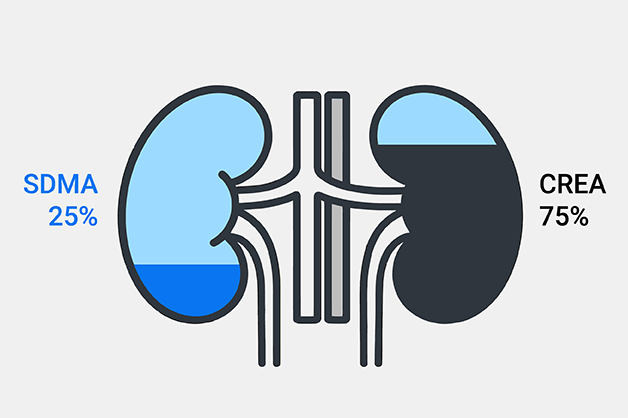
SDMA detects CKD earlier than creatinine.1–3
SDMA detects kidney issues when renal function has declined as little as 25%. Creatinine only detects kidney issues when renal decline has already reached 75%.1–3

SDMA and creatinine together improve kidney evaluation.
Creatinine alone misses 30% of sick cats and dogs with decreased kidney function.4 SDMA and creatinine together are needed to fully evaluate kidney function.
Even a mildly elevated SDMA result may signal trouble ahead.
A mild, persistent increase in SDMA often isn’t mild at all. Within a year, nearly half of cats and dogs also show rising creatinine, indicating worsening kidney disease.5

Diagnosing CKD earlier helps pets live longer.
One recent study6 shows early diagnosis and treatment of CKD slows disease progression and helps pets live longer. In fact, cats diagnosed at IRIS CKD Stage 1 or 2 and managed with a renal diet experienced:
- An average 11-month delay in disease progression.
- A 30% lower risk of all-cause death in the first 3 years.
- Cats that died during the first 3 years after diagnosis lived an average of 20% longer when they received treatment.
Let SDMA tell you more about your patients.
Because the kidneys are sensitive to various stresses, SDMA can be an early indicator of primary kidney diseases as well as the impact of other illnesses on kidney health.†
Diseases of the kidneys
- Chronic kidney disease
- Acute kidney injury
- Pyelonephritis
- Urolithiasis
- Glomerulonephritis
- Congenital disease
Disease processes affecting the kidneys
- Hyperthyroidism
- Vector-borne disease
- Systemic hypertension
- Cardiorenal syndrome
- Lower urinary obstruction
- Sepsis
- Cancer
- Drug toxicity
The many advantages of SDMA are backed by peer-reviewed studies.
Less impacted by extrarenal factors7,8
Unlike creatinine and urea, SDMA is not affected by factors that can overestimate GFR. SDMA is specific for kidney function and less impacted by extrarenal factors, including body condition, advanced age, and disease state.
More reliable than creatinine1–3,7,8
Because SDMA isn’t affected by factors like muscle mass, diet, and sex, it’s more reliable than creatinine in assessing kidney function in aging cats with muscle wasting.8,9
Increases earlier than creatinine in cats3
Results of a retrospective longitudinal study2 that includes 21 cats with CKD show that SDMA increased 17 months earlier than serum creatinine on average (range 1.5–48 months).
Increases earlier than creatinine in dogs2
SDMA increases earlier than creatinine in dogs with CKD. Results of a retrospective longitudinal study3 that includes 19 dogs with CKD show that SDMA increased 9.8 months earlier than serum creatinine on average (range 2.2–27 months).

Keep these 5 patients top of mind.
Nearly any patient can benefit from SDMA. Here are the 5 patients that can benefit most.
Healthy pets during routine check-ups.
Establish a baseline because a lack of clinical signs doesn’t necessarily indicate good health.
Cats with hyperthyroidism.
A significant number of cats with hyperthyroidism have concurrent kidney disease, as both conditions are common in older cats.13
Preanesthetic patients.
SDMA can improve recognition of at-risk patients and allow for well-informed and educated decisions regarding anesthetic choices and timing.
Patients that test positive for infections and vector-borne disease exposure.
Including SDMA testing with diagnostic profiles for patients that test positive for exposure to tick-borne disease can increase awareness of long-term health considerations.10–12
Patients presenting for nonwellness visits.
Monitoring kidney health is vitally important to any patient presenting with a medical issue. Treatment success is dependent upon management both during and after a medical event.
For a deeper dive into the data and research behind each of these patient cases and how SDMA can help, download the guide.
Two ways to unlock insights.
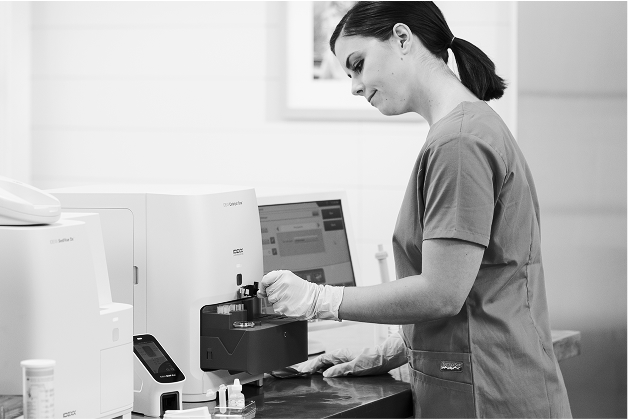
In-house laboratory
The Catalyst SDMA Test gives you in-house speed with flexible profiles tailored to your patients and practice.
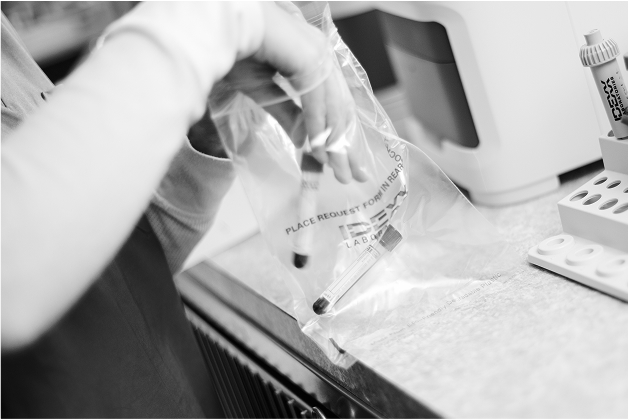
Reference laboratory
With IDEXX Reference Laboratories, SDMA is included in every chemistry panel or can be ordered on its own.
FAQs
Three key attributes make the IDEXX SDMA Test an ideal test for assessing kidney function:
Biomarker for kidney function: Symmetric dimethylarginine (SDMA) is excreted by the kidneys. SDMA is an earlier indicator of changes in glomerular filtration rate (GFR) in dogs and cats.1–3,14
Earlier than creatinine: SDMA increases as early as 25% loss of kidney function,2 making SDMA more reliable in both acute or active kidney injury and chronic kidney disease.1–3 Creatinine cannot identify kidney issues until almost 75% of kidney function is lost.1,3
Specific for kidney function: SDMA is less impacted by extrarenal factors than creatinine, including body condition, advanced age, and disease state.7,8
SDMA is also not affected by lean body mass, making it more reliable for assessing kidney function in animals with chronic kidney disease or other conditions that result in weight and muscle loss, such as hyperthyroidism.7,8,14
A new study shows that early diagnosis and treatment of chronic kidney disease improves outcomes. Cats diagnosed at IRIS CKD Stage 1 or 2 and managed with a renal diet experienced an average 11-month delay in disease progression, which is a 30% reduction in all cause mortality within the first 3 years after diagnosis. And those that died lived an average 20% longer than those not treated with a renal diet.6
SDMA is highly sensitive with studies supporting sensitivity as high as 100%.3,15–17
Creatinine: SDMA is a reliable and sensitive indicator of kidney function in animals. SDMA increases earlier than creatinine in dogs and cats with both AKI and CKD,1–3
and unlike creatinine, SDMA is not impacted by lean muscle mass.7,8 SDMA increases on average with 40% loss of kidney function vs. creatinine,1,3 which does not increase until up to 75% of kidney function is lost.1,3 Creatinine is a breakdown product of muscle, and therefore, it is impacted by lean body mass, whereas SDMA is not.8
Blood urea nitrogen (BUN): BUN also increases later than SDMA, and it can be influenced by decreased production in liver disease and increases with high-protein meals or gastrointestinal bleeding vs. SDMA, with little to no extrarenal impacts.8
Urine specific gravity (USG): Loss of urine concentrating ability progresses with kidney disease and dysfunction, and it is apparent before metabolic wastes, such as BUN and creatinine, increase. This change occurs with approximately 67% loss of nephron function but is variable.18 SDMA may increase in patients with early kidney disease that can still concentrate their urine. Natural fluctuations in USG are common in healthy animals and are influenced by how much the animal drinks before urine collection. Poor urine concentration is not specific to the kidney, and it can be influenced by other diseases (e.g., diabetes, liver disease, and Cushing’s disease), whereas SDMA is influenced by changes in GFR.15 Finding a persistently increased IDEXX SDMA concentration and inappropriately concentrated urine suggests kidney disease is probable, and immediate action should be taken.9
Urine protein:creatinine (UPC) ratio: The UPC ratio is a urine test. It is used to fully quantify protein detected in the urine once transient proteinuria, urinary tract infection, inflammation, or significant hematuria have been ruled out. The UPC ratio may detect kidney disease earlier than creatinine if the primary target of the disease is the glomerulus and in some cases of tubulointerstitial disease. However, it is common for the UPC ratio to remain normal in animals with CKD, especially in early stages when SDMA may be increased. Persistent proteinuria that results in UPC ratios greater than 0.4 in cats and 0.5 in dogs, where prerenal and postrenal proteinuria have been ruled out, is consistent with glomerular or tubulointerstitial CKD, whereas UPC ratios greater than 2.0 are strongly suggestive of glomerular disease. In animals with proteinuria, the UPC ratio should be used to monitor progression and response to treatment.19
SDMA is excreted from the kidneys; therefore, as kidney function or GFR decreases, SDMA increases. Studies have shown a very strong correlation between SDMA and GFR in dogs and cats.1,3 A benefit of using SDMA along with creatinine, which typically increases above the reference interval when there is up to a 75% reduction in GFR,1,3 is that SDMA increases when there is, on average, a 40% decrease in GFR.1,3 In some cases, SDMA increases earlier when there is 25% reduction of GFR, representing 25% loss of kidney function.2,3
Performing a GFR clearance test is the gold standard for measuring GFR and assessing kidney function. However, performing a GFR clearance test is expensive, cumbersome, and not routinely done in practice.
SDMA correlates well with GFR, increasing when there is, on average, a 40% loss of kidney function,1,3 and as little as 25% loss.2 Reduced urine concentrating ability typically appears when there is, on average, a 67% loss of GFR, but this is variable.20 Cats with experimentally induced kidney disease retained concentrating ability despite loss of 75% of renal mass.21 Given the lack of correlation between GFR and USG, a linear relationship between SDMA and USG could not be expected.
SDMA will, however, typically increase before isosthenuria associated with renal dysfunction develops. In many cases of early CKD, where SDMA is increased but creatinine is normal, the dog or cat will have an inappropriate USG (i.e., less than 1.030 for dogs or less than 1.035 for cats). However, in more than 25% of dogs and cats with an increased SDMA, significant urine concentrating ability will still remain because their GFR is only mildly decreased, or because of the variable timing of loss of concentrating ability. In patients with persistently increased SDMA where dehydration has been excluded, kidney disease is probable and should be further investigated, even if appropriate urine concentrating ability is noted.4
Untreated hyperthyroid cats have increased glomerular filtration rate (GFR) and loss of muscle mass secondary to their hyperthyroidism, which can hide underlying CKD. The IDEXX SDMA Test is a more reliable indicator of kidney function than creatinine in hyperthyroidism because, unlike creatinine, the IDEXX SDMA Test is not affected by lean body mass and appears to be only slightly blunted by hyperfiltration.22,23
Learn more about the comprehensive kidney care diagnostics and support available from IDEXX.
Note: SDMA is symmetric dimethylarginine.
†These IDEXX SDMA medical claims are supported by extensive scientific evidence.
References
- Hall JA, Yerramilli M, Obare E, Yerramilli M, Almes K, Jewell DE. Serum concentrations of symmetric dimethylarginine and creatinine in dogs with naturally occurring chronic kidney disease. J Vet Intern Med. 2016;30(3):794–802. doi:10.1111/jvim.13942
- Nabity MB, Lees GE, Boggess MM, et al. Symmetric dimethylarginine assay validation, stability, and evaluation as a marker for the early detection of chronic kidney disease in dogs. J Vet Intern Med. 2015;29(4):1036–1044. doi:10.1111/jvim.12835
- Hall JA, Yerramilli M, Obare E, Yerramilli M, Jewell DE. Comparison of serum concentrations of symmetric dimethylarginine and creatinine as kidney function biomarkers in cats with chronic kidney disease. J Vet Intern Med. 2014;28(6):1676–1683. doi:10.1111/jvim.12445
- Data on file at IDEXX Laboratories, Inc. Westbrook, Maine USA: In-house Diagnostics All-Cause Diagnostics Findings, 100219 (IHD Diagnostic Utilization, IDEXX Global Medical Organization—Medical Data Insights, 2022).
- Mack RM, Hegarty E, McCrann DJ, Michael HT, Grauer GF. Longitudinal evaluation of symmetric dimethylarginine and concordance of kidney biomarkers in cats and dogs. Vet J. 2021;276:105732. doi:10.1016/j.tvjl.2021.105732
- Coyne M, Szlosek D, Webeck J, et al. Use of a veterinary therapeutic renal diet in cats with early chronic kidney disease is associated with slower disease progression and improved survival. JAVMA. Preprint posted online January 14, 2026. doi:10.2460/javma.25.10.0665
- Hall JA, Yerramilli M, Obare E, Yerramilli M, Yu S, Jewell DE. Comparison of serum concentrations of symmetric dimethylarginine and creatinine as kidney function biomarkers in healthy geriatric cats fed reduced protein foods enriched with fish oil, L-carnitine, and medium-chain triglycerides. Vet J. 2014;202(3):588–596. doi:10.1016/j.tvjl.2014.10.021
- Hall JA, Yerramilli M, Obare E, Yerramilli M, Melendez LD, Jewell DE. Relationship between lean body mass and serum renal biomarkers in healthy dogs. J Vet Intern Med. 2015;29(3):808–814. doi:10.1111/jvim.12607
- Mack RM, Hegarty E, McCrann DJ, Michael HT, Grauer GF. Longitudinal evaluation of symmetric dimethylarginine and concordance of kidney biomarkers in cats and dogs. Vet J. 2021;276:105732. doi:10:1016/j.tvjl.2021.105732
- Burton W, Drake C, Ogeer J, et al. Association between exposure to Ehrlichia spp. and risk of developing chronic kidney disease in dogs. J Am Anim Hosp Assoc. 2020;56(3):159–164. doi:10.5326/JAAHA-MS-7012
- Drake C, Coyne M, McCrann DJ, Buch J, Mack R. Risk of development of chronic kidney disease after exposure to Borrelia burgdorferi and Anaplasma spp. Top Companion Anim Med. 2021;42:100491. doi:10.1016/j.tcam.2020.100491
- Little S, Levy J, Hartmann K, et al. 2020 AAFP feline retrovirus testing and management guidelines. J Feline Med Surg. 2020;22(1):5–30. doi:10.1177/1098612X19895940
- Vaske HH, Schermerhorn T, Grauer GF. Effects of feline hyperthyroidism on kidney function: a review. J Feline Med Surg. 2016;18(2):55–59. doi:10.1177/1098612X15575385
- DeMonaco SM, Panciera DL, Morre WA, Conway T, Werre S. Symmetric dimethylarginine in hyperthyroid cats before and after treatment with radioactive iodine. J Feline Med Surg. 2020;22(6):531–538. doi:10.1177/1098612X19859947
- Sargent HJ, Elliott J, Jepson RE. The new age of renal biomarkers: does SDMA solve all of our problems? J Small Anim Pract. 2021;62(2):71–81. doi:10.1111/jsap.13236
- McKenna M, Pelligand L, Elliott J, Cotter D, Jepson R. Relationship between serum iohexol clearance, serum SDMA concentration, and serum creatinine concentration in non-azotemic dogs. J Vet Intern Med. 2020;34(1):186–194. doi:10.1111/jvim.15659
- Brans M, Daminet S, Mortier F, Duchateau L, Lefebvre HP, Paepe D. Plasma symmetric dimethylarginine and creatinine concentrations and glomerular filtration rate in cats with normal and decreased renal function. J Vet Intern Med. 2021;35(1):303–311. doi:10.1111/jvim.15975
- Lulich JP, Osborne CA, O’Brien TD, Polzin DJ. Feline renal failure: questions, answers, questions. Compend Contin Educ Pract Vet. 1992;14(2)127–153.
- IRIS Canine GN Study Group Diagnosis Subgroup, Littman MP, Daminet S, Grauer GF, Lees GE, van Dongen AM. Consensus recommendations for the diagnostic investigation of dogs with suspected glomerular disease. J Vet Intern Med. 2013;27(Supp 1):S19–S26. doi:10.1111/jvim.12223
- Rytlewski K, Olszanecki R, Korbut R, Zdebski Z. Effects of prolonged oral supplementation with L-arginine on blood pressure and nitric oxide synthesis in preeclampsia. Eur J Clin Invest. 2005; 35(1):32–37. doi:10.1111/j.1365-2362.2005.01445.x
- DiBartola SP, Rutgers HC, Zack PM, Tarr MJ. Clinicopathologic findings associated with chronic renal disease in cats: 74 cases (1973–1984). JAVMA. 1987;190(9):1196–1202.
- Szlosek D, Robertson J, Quimby J, et al. A retrospective evaluation of the relationship between symmetric dimethylarginine, creatinine and body weight in hyperthyroid cats. PLoS One. 2020;15(1):e0227964. doi:10.1371/journal.pone.0227964
- Peterson M, Varela F, Rishniw M, and Polzin DJ. Evaluation of serum symmetric dimethylarginine concentration as a marker for masked chronic kidney disease in cats with hyperthyroidism. J Vet Intern Med. 2018;32(1):295–304. doi:10.1111/jvim.15036